The Real Cost of a Bad Engineering Hire in 2026
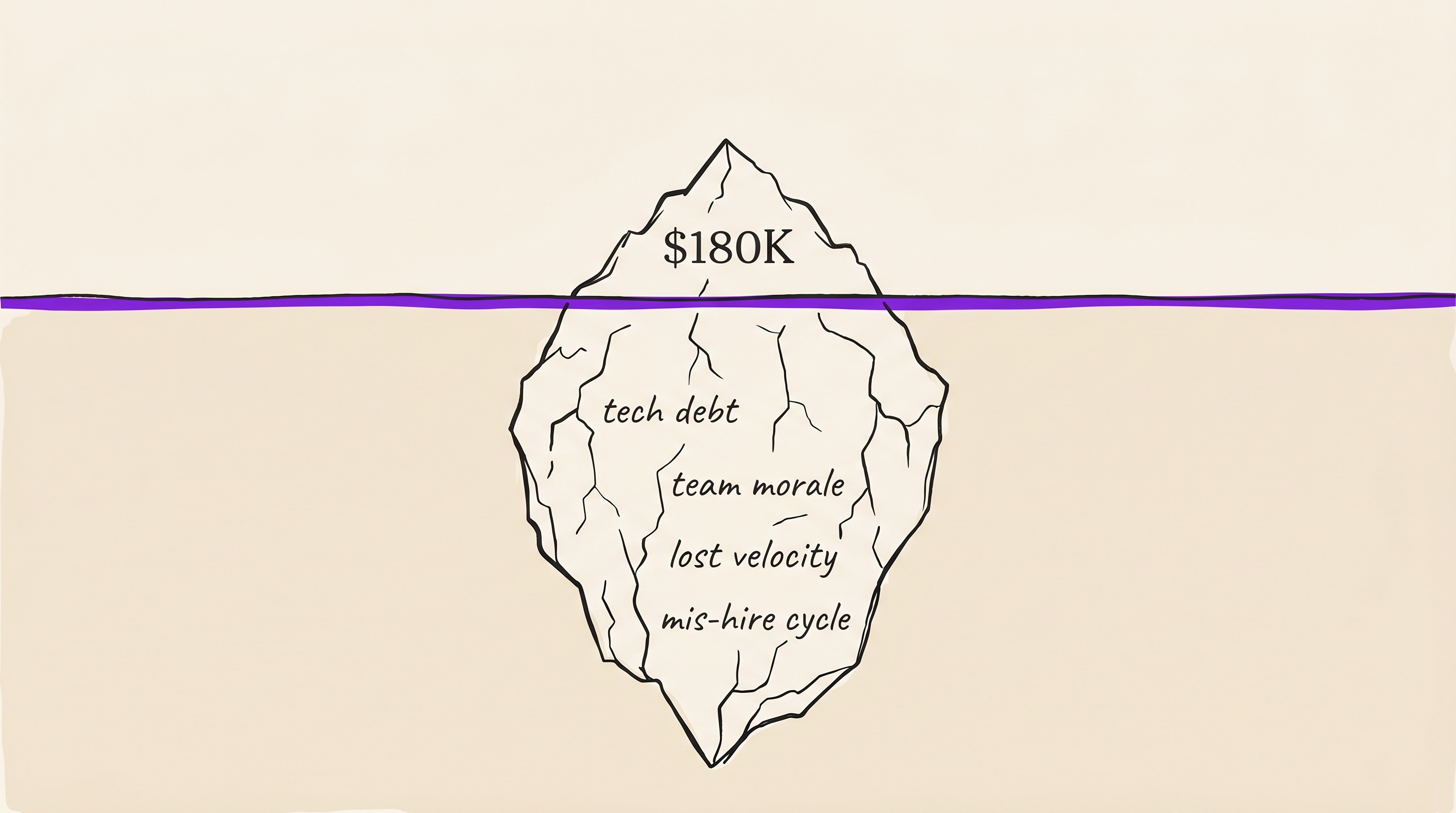
A bad senior engineering hire costs between $150,000 and $300,000. But in engineering, the real cost is worse. It includes technical debt that outlives the employee, team velocity that takes months to recover, and hiring decisions that cascade downstream.
Eval-X is an AI-era technical interview platform that replaces gut-feeling hiring decisions with evidence-based, multi-dimensional evaluation. We built it because we lived the cost of bad hires firsthand.
The number everyone quotes (and why it's too low)
The U.S. Department of Labor puts a bad hire at 30% of first-year salary. For a senior engineer at $180,000, that's $54,000. SHRM's estimate is broader: 50-200% of annual salary, or $90,000-$360,000.
Both numbers undercount the real damage because they measure what's easy to count: recruiting fees, severance, and backfill costs. They miss what's hard to count: the six months of suboptimal output, the senior engineers who spent their time compensating instead of shipping, and the code that needs rewriting 18 months later.
Let me break down what I've seen across five CTO/VP R&D roles and 1,000+ technical interviews.
The full cost breakdown: seven layers
Layer 1: Direct recruiting costs ($15,000-$40,000)
This is the easy math. Recruiter fees (typically 20-25% of first-year salary for a senior role), job board postings, sourcing tools, and the hours your team spent interviewing. For a $180K senior engineer sourced through an agency, recruiting alone runs $36,000-$45,000. Internal recruiting is cheaper per hire but still consumes 40-60 hours of engineering time across the interview loop.
Layer 2: Onboarding and ramp ($20,000-$35,000)
A new engineer takes 3-6 months to reach full productivity. During that ramp, you're paying full salary for partial output. The engineer assigned to mentor them loses 10-15% of their own productivity. Architecture walkthroughs, environment setup, access provisioning, code review of early PRs - it adds up. For a bad hire who leaves at month 4, you've invested 4 months of ramp with zero return.
Layer 3: Suboptimal output ($30,000-$80,000)
This is the layer most companies never calculate. A bad hire doesn't produce zero value - they produce negative value disguised as progress. Code that technically works but creates maintenance burden. Architecture decisions that seem reasonable in isolation but create coupling problems at scale. PRs that pass review because nobody has time to push back on a questionable approach.
I watched this pattern repeat at every scale. At LSports, scaling from 15 to 120+ engineers, a single bad senior hire in the data pipeline team produced code that worked in testing but failed under production load patterns. The direct fix took two weeks. The architectural debt from their design choices took six months to unwind.
Layer 4: Team velocity drag ($40,000-$100,000)
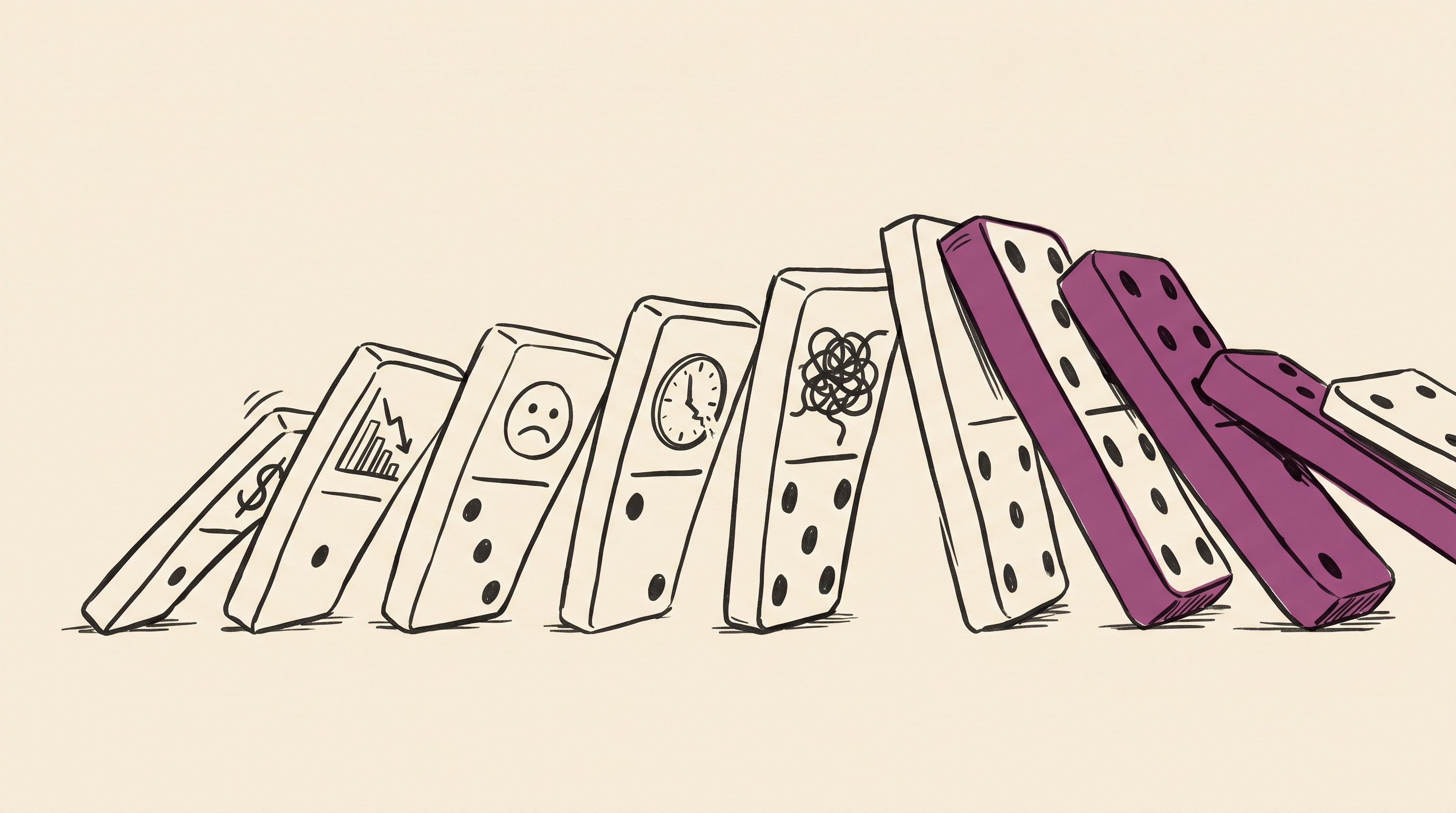
A bad hire doesn't just underperform - they slow down everyone around them. Senior engineers spend time reviewing poor code, re-explaining architecture decisions, and fixing production incidents caused by shortcuts. A single underperformer in a 6-person team can reduce team velocity by 20-30%.
The math: if your team's loaded cost (salary + benefits + overhead) is $150K/person, a 25% velocity hit on 5 other team members for 4 months costs $62,500 in lost output. This number is real. It shows up in missed sprint commitments, delayed releases, and features that slip a quarter.
Layer 5: Team morale and attrition risk ($50,000-$200,000)
The silent killer. Strong engineers don't tolerate working alongside someone who can't carry their weight. They don't always leave immediately, but they disengage. They stop volunteering for hard problems. They update their LinkedIn. When they eventually leave, you've lost $200K+ in replacement cost for someone who was performing - not the person who wasn't.
In a 2024 CareerBuilder study, 75% of employers admitted to making a bad hire. The ones who tracked downstream effects reported that team morale was the most damaging consequence, ahead of direct financial cost.
Layer 6: Technical debt ($25,000-$150,000)
Bad code outlives bad hires. The features they shipped, the patterns they established, the tests they didn't write - all of it becomes maintenance burden for the team that stays. The cost materializes as increased bug rates, longer development cycles on adjacent features, and eventually a "rewrite" project that consumes engineering capacity for months.
If you've ever seen a Slack message that says "nobody touch the payment module, we'll refactor it next quarter" - there's a good chance a bad hire built that module.
Layer 7: Opportunity cost (unquantifiable but real)
Every month spent managing a bad hire is a month not spent on: shipping the feature that would have won the enterprise deal, improving the developer experience that would have reduced churn, or building the infrastructure that would have supported 10x growth. This is the cost that doesn't appear on any spreadsheet but determines whether you hit your next milestone.
The total: $180,000 to $605,000+
| Cost Layer | Low Estimate | High Estimate |
|---|---|---|
| Direct recruiting | $15,000 | $40,000 |
| Onboarding and ramp | $20,000 | $35,000 |
| Suboptimal output | $30,000 | $80,000 |
| Team velocity drag | $40,000 | $100,000 |
| Morale and attrition risk | $50,000 | $200,000 |
| Technical debt | $25,000 | $150,000 |
| Total (without opportunity cost) | $180,000 | $605,000 |
For a senior engineer at $180K base salary, a bad hire costs 1x-3.4x their annual compensation when you count everything. The DOL's "30% of salary" figure is off by a factor of 3-6.
Why this is getting worse in the AI era
The cost of a bad hire has always been high. But three shifts in 2024-2026 have made it worse.
AI amplifies both good and bad engineers. A strong engineer with AI tools ships 3-5x faster than they did without AI. A weak engineer with AI tools ships code that looks competent on the surface but crumbles under scrutiny. The gap between good and bad hires is wider than it's ever been, which means the cost of getting it wrong is higher.
Traditional interview signals have degraded. LeetCode problems are solved by ChatGPT in seconds. Take-home tests are indistinguishable from AI-generated output. Technical trivia is obsolete when every engineer has an LLM in their IDE. The signals that used to predict performance no longer work, which means false positive rates in hiring are climbing.
Detection creates false confidence. Some platforms respond to AI in interviews by trying to detect and block it. This creates an arms race that detection will always lose - and gives hiring teams false confidence that their process is working when it isn't.
The result: 100% of the 20+ CTOs and VPs I've interviewed confirmed that they now rely on gut feeling for senior hiring decisions. When your $180K hiring decision comes down to "I think they'll be good," you're not managing risk. You're rolling dice.
What better evaluation actually looks like
The antidote to bad hires isn't more interviews or harder puzzles. It's better signal.
The multi-dimensional evaluation framework we use at Eval-X scores candidates across six dimensions: Problem Framing (15%), AI Usage Quality (20%), System Design (20%), Code Quality (15%), Adaptability (15%), and Explanation and Ownership (15%). Each dimension maps to a specific predictor of on-the-job performance.
This matters for cost reduction because:
1. You catch false positives before they become hires. A candidate who scores well on Code Quality but poorly on AI Usage Quality will produce code that works in isolation but doesn't use the AI tools your team relies on daily. That's the profile that looks good in a traditional interview and underperforms in the first quarter.
2. You reduce time-to-decision. Instead of 5-round interview loops that take 3 weeks, you get a structured evaluation in a single session. Faster decisions mean less candidate dropoff, which means you're not losing strong candidates while deliberating on weak ones.
3. You create defensible hiring decisions. When a hiring debrief starts with "I thought they were good" versus "they scored 82 on System Design but 41 on Adaptability, and here's the session recording showing why" - the second conversation produces better outcomes.
The difference between evaluating what engineers build versus how they think is the difference between catching bad hires in the interview and catching them at month 4 when the damage is already done.
The ROI math
If your engineering team makes 10 senior hires per year and your false positive rate is 23% (industry average per SHRM data), you're making roughly 2 bad hires annually. At $180K-$605K per bad hire, that's $360K-$1.2M in annual waste.
Reducing false positives from 23% to 10% saves 1.3 bad hires per year, or $234K-$786K.
An evaluation platform costs a fraction of a single bad hire. The ROI isn't close.
Sources
Frequently asked questions
What is the average cost of a bad engineering hire?
The average cost ranges from $150,000 to $300,000 for mid-to-senior software engineers when you include direct costs (recruiting, severance), indirect costs (team velocity drag, technical debt), and opportunity costs. The U.S. Department of Labor estimates 30% of first-year salary in direct costs alone, but total costs typically reach 1x-3x annual salary.
How do you calculate the cost of a bad hire?
Calculate across seven layers: direct recruiting costs, onboarding investment, suboptimal output during tenure, team velocity drag on surrounding engineers, morale and attrition risk, technical debt left behind, and opportunity cost. Most companies only count layers 1 and 2, which underestimates the true cost by 3-6x.
How can AI help reduce bad hires in engineering?
AI-native evaluation platforms like Eval-X capture the full behavioral timeline of how a candidate thinks, prompts AI tools, and makes engineering decisions - not just whether their code compiles. Multi-dimensional scoring across problem framing, AI usage quality, system design, code quality, adaptability, and explanation reduces false positives by evaluating signal that traditional interviews miss entirely.
What percentage of engineering hires are bad hires?
Industry data from SHRM and CareerBuilder suggests that roughly 23% of companies report making multiple bad hires annually, with 75% of employers admitting to at least one. In engineering specifically, where interview signals have degraded due to AI tools, false positive rates may be even higher.
How long does it take to identify a bad engineering hire?
Most bad engineering hires are identified between month 3 and month 6, after the onboarding honeymoon period ends and the engineer faces real architectural decisions, production pressure, and cross-team collaboration. By that point, the sunk cost in recruiting, onboarding, and team disruption is already substantial.
Stop rolling the dice on $180K hiring decisions.
See how Eval-X replaces gut feeling with multi-dimensional evaluation data. 20 minutes. No slides.
Book a Demoarrow_forward