Eval-X vs HackerRank: Detecting Cheating vs. Evaluating Collaboration
Two fundamentally different architectures for technical assessment in 2026. An honest, sourced look at what each platform is built to do, and how to choose the right one for your next senior hire.
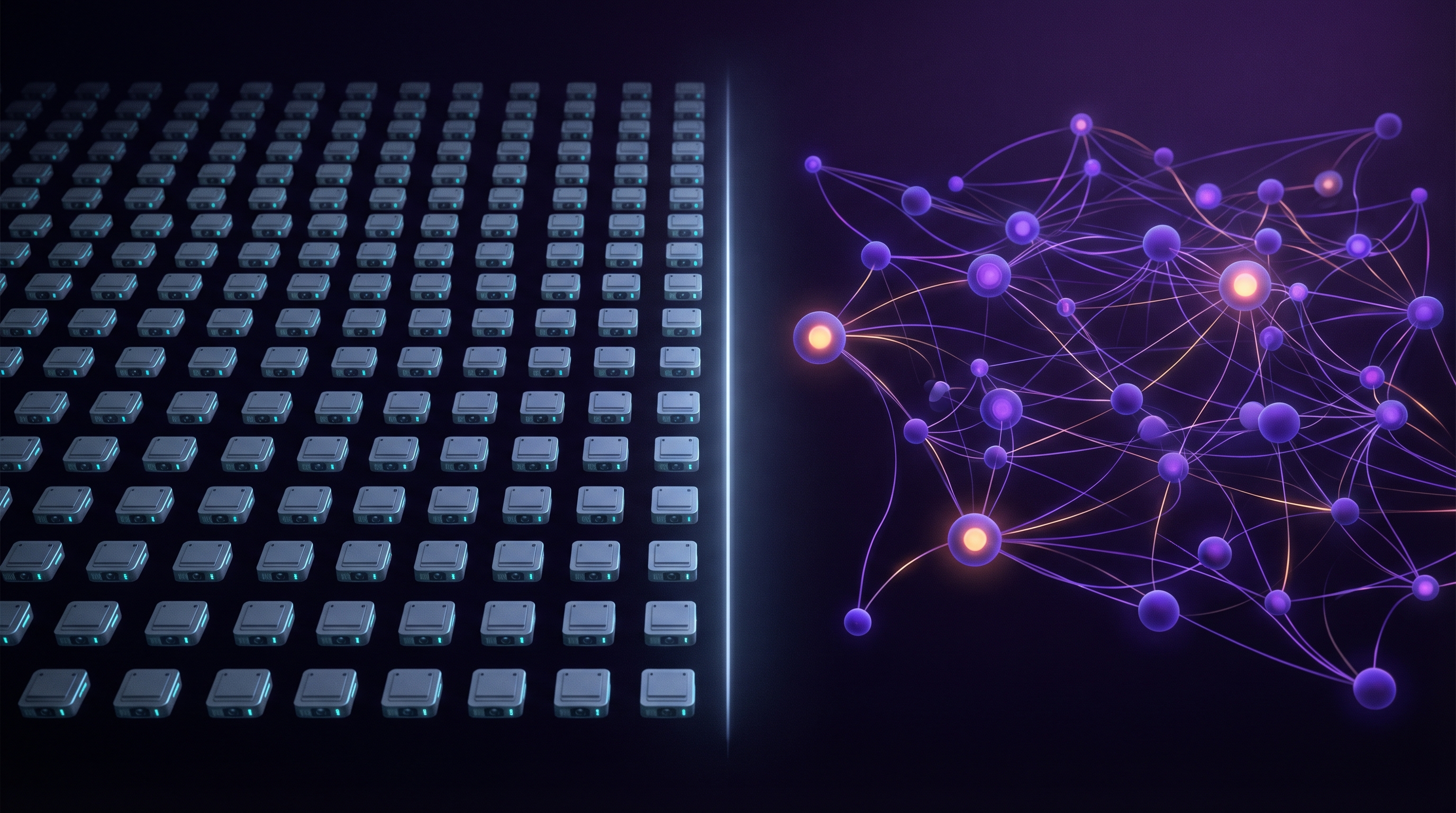
A category question, not a feature question
The question hiring teams are actually asking in 2026 is not which coding platform has the biggest question bank. It is this: how do we evaluate engineers who work with AI?
Two broad categories of answers exist in the market today. The first category is built to answer a compliance question: did the candidate follow the rules, and if they broke them, can we catch it? The second category is built to answer an evaluation question: across multiple dimensions, how well does this candidate actually work when AI is part of the loop?
Both categories produce outputs. One produces a log. The other produces a hiring signal. This post is about why that difference matters when a team sits down to choose a platform, and why teams looking for a HackerRank alternative keep arriving at the same observation: detecting misuse of AI is a different problem than evaluating collaboration with it.
What HackerRank actually does in 2026
HackerRank has been clear about its stance, and a fair comparison starts with an accurate account of its product.
On the integrity side, HackerRank operates two environments. Proctor Mode applies behavioral analysis during the assessment: typing cadence, copy and paste tracking, tab switching, and pattern detection fed into risk scoring. Secure Mode layers on a locked browser and stricter environmental controls. HackerRank publicly claims 85 to 93 percent precision on its AI plagiarism engine, which correlates similarity scores, timing anomalies, and behavioral signals before escalating high-risk sessions to human review.1
On the AI usage side, HackerRank has also shipped an AI-assisted IDE. Candidates can use an AI Assistant that is auto-enabled inside certain assessments, and the recruiter report includes a Chat Transcript of the candidate's conversation with the assistant.2 HackerRank describes this as giving recruiters visibility into "support-seeking behavior, coding independence, and AI fluency."3
Publicly, HackerRank's framing is consistent. Co-founder and CEO Vivek Ravisankar has described the shift as "an AI revolution that is poised to change the very nature of what it means to be a developer and write code," and HackerRank has positioned itself as leading "an AI-first hiring process."4 The company's stated philosophy on integrity is that "integrity isn't about whether candidates use AI or not. It's about fairness, making sure everyone follows the same rules, and knowing you can trust the results."5
This is a serious, well-engineered product. None of what follows is a claim that HackerRank is bad at what it does. It is a claim that what HackerRank is built to do, and what AI-era engineering hiring requires, are not the same thing.
What that architecture is optimized for
Read those two surfaces together, the proctoring stack and the chat transcript, and the shape of the product becomes clear. Both are built to answer one question: did the candidate follow the rules?
In Proctor Mode and Secure Mode, the rule is "no unauthorized external assistance," and the output is a binary with evidence attached: clean session, or flagged session with a risk score. In the AI-assisted IDE, the rule is "you can use the AI Assistant, and your conversation will be logged," and the output is a transcript the recruiter can scan after the fact.
Both outputs are compliance artifacts. They verify that a rule was followed, or produce evidence that it was not. Even HackerRank's own framing, "same rules for everyone, and knowing you can trust the results," is a definition of integrity that lives at the rule layer, not at the evaluation layer.
This is a reasonable architecture for the problem it solves. In high-volume, top-of-funnel screening, where thousands of candidates are funneled through coding assessments before a human ever reviews them, rule-level integrity is table stakes. If you cannot trust the session, nothing downstream of it matters.
The issue surfaces further down the funnel, at the point where a team is actually deciding whether to hire a specific engineer. At that point, the question is no longer "did they follow the rules." The question is "what did they demonstrate."

The evaluation problem HackerRank's architecture does not solve
Consider what a senior engineering manager actually wants to know about a candidate in 2026.
How does this candidate decompose an unfamiliar problem when they have an AI assistant available? Do they sketch the shape of the solution before prompting, or do they outsource the thinking? When the model returns a confident but subtly wrong answer, do they notice? How do they recover? When two AI suggestions conflict, on what basis do they choose between them? When they hit a bug the model cannot fix, how do they reason about it? How do they communicate the trade-offs in their final approach to a teammate who did not watch them work?
None of these are rule violations. They are behaviors. You cannot detect them by running a plagiarism engine across the final code, because the final code does not contain them. You cannot reconstruct them from a chat transcript, because the transcript records what was typed, not how decisions were made, what was rejected and why, how the candidate reasoned about model output, or how their approach evolved across the session.
This is the gap. Detection architecture is built around the negative space of rule violations. Evaluation architecture has to be built around the positive space of engineering behavior, captured while the work is happening, across enough dimensions to tell a reliable story about how the candidate thinks.
A team that ships a HackerRank result directly into a hire decision is implicitly assuming that rule compliance plus a passing score plus a chat transcript adds up to a hiring signal. At any level of the funnel, that assumption falls short of what modern engineering hiring actually requires, because the work engineers do today is dominated by exactly the behaviors a detection architecture is not designed to see. The cost of getting it wrong scales with seniority, but the evaluation gap exists at every level.
What Eval-X does differently
Eval-X was built from the opposite starting point. The product is a multi-dimensional evaluation framework, starting with 6 dimensions and expanding as AI-era workflows evolve. The dimensions cover how a candidate decomposes problems, how they collaborate with AI, how they recover from error, how they communicate trade-offs, and other behaviors that distinguish engineers who produce reliable senior-level work from engineers who produce plausible output.
The evidence the platform captures reflects that framework. Not just the final code, but the trajectory: the way the candidate approached the problem, the prompts and responses at the decision points that mattered, what they accepted, what they modified, what they rejected, how they iterated when something broke, and how they articulated the reasoning behind their final approach.
That evidence rolls up into a scorecard. The scorecard is not a pass/fail on whether rules were followed. It is a multi-dimensional read on whether this candidate demonstrates the kind of engineering behavior the team is hiring for. A strong candidate and a weak candidate can both produce working code in 2026, because the AI often will. The scorecard is built to surface the difference underneath that surface.
This is why Eval-X does not lead with "we detect AI misuse." The premise is different. The premise is that AI is part of how engineers work now, the question is no longer whether they use it, and a platform's job is to produce a defensible hiring signal about how well they use it, across enough dimensions to hold up to scrutiny.
A chat transcript can be forwarded. A multi-dimensional evaluation can be defended in a hiring committee.
An honest read: who should pick which
Not every team needs Eval-X. A clear-eyed comparison means naming when HackerRank is the right call.
Choose HackerRank if the primary job the platform has to do is high-volume, top-of-funnel screening at scale, where the dominant risk the team is managing is rule violation, and where there is substantial downstream human interviewing that will surface the evaluation signal after the screen. HackerRank's question bank, enterprise footprint, and detection stack are built for that job, and they do it well.
Choose Eval-X if the platform has to produce a defensible hiring signal on engineers whose daily work is collaborative, AI-assisted problem solving, and the cost of a false positive is measured in six figures and months of ramp. That is the domain where detection architecture runs out of runway and evaluation architecture earns its keep. Eval-X is built for teams making senior and staff-level hires in the AI era, where "they passed the coding test" is no longer a sufficient answer to "should we hire them."
Some teams will need both. Use HackerRank or similar for early-funnel volume, use Eval-X for the hires where the evaluation signal has to hold up. That is a reasonable split, and it is often how larger hiring operations end up configuring their stack.

The line worth keeping
A chat transcript tells you what was typed. A multi-dimensional evaluation tells you whether to hire.
Both are valid products. They solve different problems. The question a hiring team has to answer before choosing a platform is which problem is actually in front of them.
For teams that have already decided the problem is evaluation, not compliance, Eval-X's design partner program is open to a small number of engineering organizations making AI-era senior hires. If that is the shape of the problem your team is solving, that conversation is the right next step.
Frequently asked questions
Is HackerRank a bad platform?
No. HackerRank is well-engineered for its purpose: high-volume rule-compliance checking and screening at scale. It is not bad - it is designed for a different problem than senior-level hiring signal.
Can I use both HackerRank and Eval-X?
Yes. Use HackerRank for early-stage volume screening where you need to filter large candidate pools quickly. Use Eval-X for senior and staff-level hires where false positives cost $150K or more.
What is the difference between detecting AI misuse and evaluating AI collaboration?
Detection checks if rules were broken. Evaluation captures how engineers actually think and work with AI - whether they drive the tool strategically or follow it blindly. For senior hires, the second signal predicts job performance.
Sources
- HackerRank, "Proctor Mode vs. Secure Mode: How HackerRank Detects ChatGPT and Other AI Cheats in 2025." hackerrank.com
- HackerRank Support, "AI-Assisted Interviews." support.hackerrank.com
- HackerRank, "How do recruiters see how candidates used AI during their tests?" hackerrank.com
- PR Newswire, "HackerRank Research Finds Generative AI Changing How Developers Code and How Companies Hire Developers." prnewswire.com
- HackerRank, "Using AI Tools Ethically in a HackerRank CodePair Interview." hackerrank.com
Evaluating senior engineers, not just screening them?
See how Eval-X produces a defensible hiring signal across the dimensions that actually predict senior performance. 20 minutes. No slides.
Book a Demoarrow_forward